Archive for » September, 2010 «

Tuesday, September 14th, 2010 | Author: admin

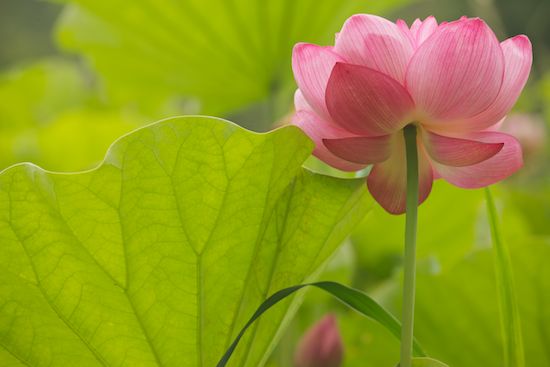
Image #20100802-408

“I love the lotus because while growing from mud, it is unstained.” Confucian scholar Zhou Duny

I have mentioned before, I am drawn to photograph water lotus and water lilies flowers and leaves. In preparing some lotus images for a client I decided to do a little research on the water lotus and discovered some interesting facts:

The plant is an aquatic perennial. Under favorable circumstances its seeds may remain viable for many years, with the oldest recorded lotus germination being from that of seeds 1300 years old recovered from a dry lakebed in northeastern China. It is often mistaken for a water lily. The lotus is a completely different plant unrelated to the water lily.

In has many uses for food. In Asian cultures the roots, leaves, and flowers are used in many recipes as garnishes, teas, medicines and soups, just to name a few.

From ancient times the lotus flower has been a divine symbol in many Asian traditions.

Share This Post
Wednesday, September 08th, 2010 | Author: Byron

Image #20100802-85

Water lotus and water lilies have long been a favorite subject of mine. I find myself producing abstracts as well as more literal interpretations of them. Recently I spent a couple of days photographing water lotus and water lilies and a few other subjects. I have posted a number of these  new images to my site or you can view a sampling of them view HERE

Share This Post
Wednesday, September 01st, 2010 | Author: Byron

50506_721

We all have a sense of the restorative and healing powers of being in the outdoors and experiencing nature. But can simply viewing art that depicts nature aid in healing our bodies? As a fine art nature photographer it is certainly an intriguing concept. One of my motivations when I create a fine art photograph is to help uplift and inspire people. It  appears that there may be some physical healing that can take place from viewing art images of nature.  Now there is evidence that looking at art that depicts nature can actually have a healing effect on our bodies. Here are some recent findings:

“In Harmony with Nature’s Blueprint” published in Interior Expressions (February 2000), Jain Malkin writes the “effect of nature on humans has been thoroughly studied… humans have physiological and emotional responses to nature.”

In recent years, Roger Ulrich, Ph.D., environmental psychologist, director of the Center for Health Systems and Design, College of Architecture, Texas A&M University, and a leading authority in the field has expounded his “Theory of Supportive Design.” Access to nature is central to this theory. The underlying premise is that “improved medical outcomes are linked to environments’ effectiveness in facilitating stress coping and restoration. Supportive design tries to eliminate stress factors and to include features that reduce stress, calm patients, strengthen coping resources… including access to nature.”

Ulrich has cited numerous studies showing that “viewing nature can produce significant recovery from stress, which in turn, can lead to cost-savings, by improving medical outcomes,” going as far back as a 1984 Science paper which stated: “patients with bedside views of nature had briefer hospital stays and needed less medication.” In a September 2000 presentation titled “Evidence-based Environmental Design for Improving Medical Outcomes,” Ulrich argued that “exposure to nature produces significant recovery.” Both psychological and physiological stress reduction are noted, as measured by “less anxiety, calmness, reduced blood pressure, muscle tension, heart and respiratory rates.”

Interesting…..

Image #20100531-13

Share This Post